


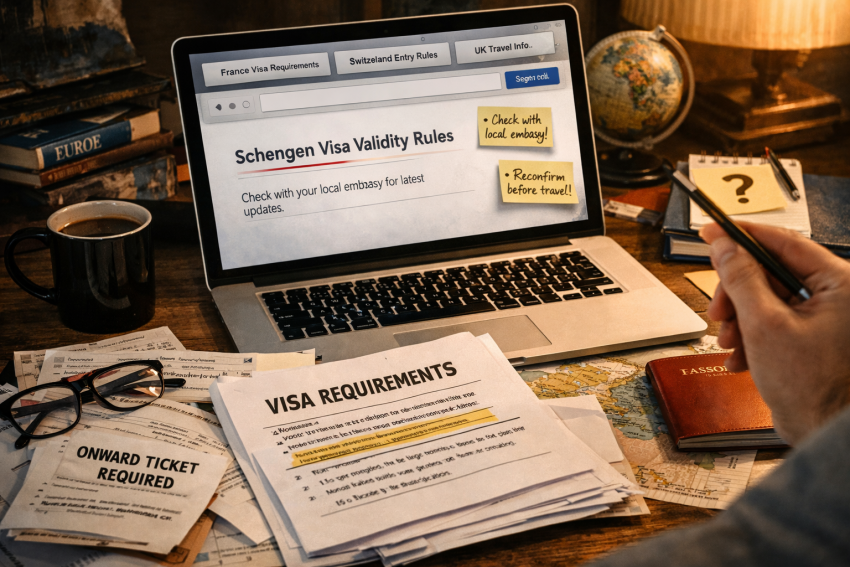
I finally reached the point where I couldn’t remember whether the confusion was mine or Europe’s.
Was it six months’ validity from the date of entry or the date of exit? Did one country care about blank pages while another cared about onward travel? And why did every answer I found come with a caveat, a footnote, or a cheerful “check with your local embassy,” which is the bureaucratic equivalent of shrugging.
After the third evening of reopening the same tabs, France, Switzerland, the UK, then back again, I stopped trying to memorize the rules and did something more honest.
I needed a single place to store the information so I could focus on the trip instead of the paperwork.
I realized the problem wasn’t the rules. It was the amount of attention they were demanding.
If you’ve been scrolling through travel Facebook groups, forums, or YouTube comments lately, you’ve probably seen the same questions over and over:
- “Do I need ETIAS in 2026 or not?”
- “Does the UK count toward the Schengen 90 days?”
- “Why does everyone say something different?”
- “Which rules apply to my passport?”
The truth is: Europe’s entry rules are changing, and much of the information circulating on social media is outdated, incomplete, or simply wrong. Different countries, different systems (Schengen vs UK), phased rollouts, and constant rumours make it frustrating, especially for travellers who just want clear answers without digging through government websites.
I wanted the rules handled once, clearly, and then left alone.
Below is a plain-English, up-to-date explanation of what travellers need for France, Switzerland, and England (for example) as Europe moves toward 2026 entry requirements, based only on legitimate official government sources, not guesswork or influencer opinions.
And if you’re tired of second-guessing, re-checking, and worrying that you’ve missed something important, this GPT was designed to help. It walks you through:
- What applies now vs what starts in 2026
- How the rules affect your specific passport
- What you actually need and what you can safely ignore
👉 Purchasing access saves hours of frustration, prevents costly mistakes, and gives you calm, reliable answers every time a rule changes without the noise of social media.
Let’s start with what you really need to know.

Please note: Paid subscribers get this in month five.What follows is exactly how the GPT responded to the request:
Here is a clear, simplified guide for travelling to England (UK), France, and Switzerland later this year.
I’ll assume you are travelling on a U.S., Canadian, UK, Australian, or EU passport. If that’s not correct, tell me, and I’ll adjust it.
✈️ Countries in Your Trip
- France – Schengen Area
- Switzerland – Schengen Area
- England (United Kingdom) – NOT Schengen
This matters because France and Switzerland share the same entry rules, whereas England has its own.
🛂 1. Passport Requirements (All Countries)
You will need:
- A valid passport
- Issued within the last 10 years
- Valid for at least 3 months beyond the date you leave Europe
- At least 1–2 blank pages
This rule applies to France and Switzerland. The UK is slightly more flexible, but it’s safest to meet this standard for the whole trip.
🇫🇷 🇨🇭 France & Switzerland (Schengen Area)
Visa
- No visa required for short tourist visits
- You may stay up to 90 days total within any 180-day period
- The 90 days is shared between France and Switzerland combined
Example:
If you spend 30 days in France and 20 days in Switzerland, you have used 50 of your 90 days.
ETIAS (Important – future rule)
- ETIAS is NOT required yet
- It is expected to start in 2026
- If your trip is this year, you do not need ETIAS
At the border, you may be asked for:
- Proof of onward or return travel
- Hotel bookings or the address of where you’re staying
- Proof of funds (rare, but possible)
🇬🇧 England (United Kingdom)
England is not part of Schengen, so it has separate rules.
Length of stay
- Most visitors can stay up to 6 months for tourism
Electronic Travel Authorization (ETA)
- The UK is introducing an ETA (Electronic Travel Authorization)
- This is not a visa, but online pre-approval
- It must be obtained before you fly
- Some nationalities already need it; others will soon
I strongly recommend checking the official UK government ETA page shortly before travel to confirm whether your passport nationality requires it.
🧮 Very Important: Time Limits Summary

Time spent in England does not reduce your 90 Schengen days.
🦠 Health & Vaccinations
- No COVID-19 vaccination or testing required
- Make sure routine vaccinations (tetanus, MMR, flu) are up to date
- No mandatory vaccines for entry
🧳 Travel Insurance (Strongly Recommended)
- Not legally required for entry
- Highly recommended, especially for older travellers
- Medical care in Switzerland can be expensive without insurance
⚠️ Safety & Scam Warning
- Do not use unofficial “visa services.”
- Do not pay anyone claiming to “speed up” ETIAS or UK ETA
- Always apply only on official government websites
✅ Your Simple Checklist
✔ Valid passport (meets Schengen rules)
✔ Track your 90 Schengen days (France + Switzerland)
✔ Check if you need a UK ETA before flying
✔ Carry proof of accommodation & return ticket
✔ Travel insurance arranged
If you’d like, tell me:
- Which passport are you travelling on
- Approximate length of stay in each country
I can then double-check everything and walk you through the exact official government pages step by step.
✨ Want more custom GPTs like this one? Visit: https://penguinsprintable.ca
P.S. Remember, this GPT that I created can be used for any country you plan to visit.